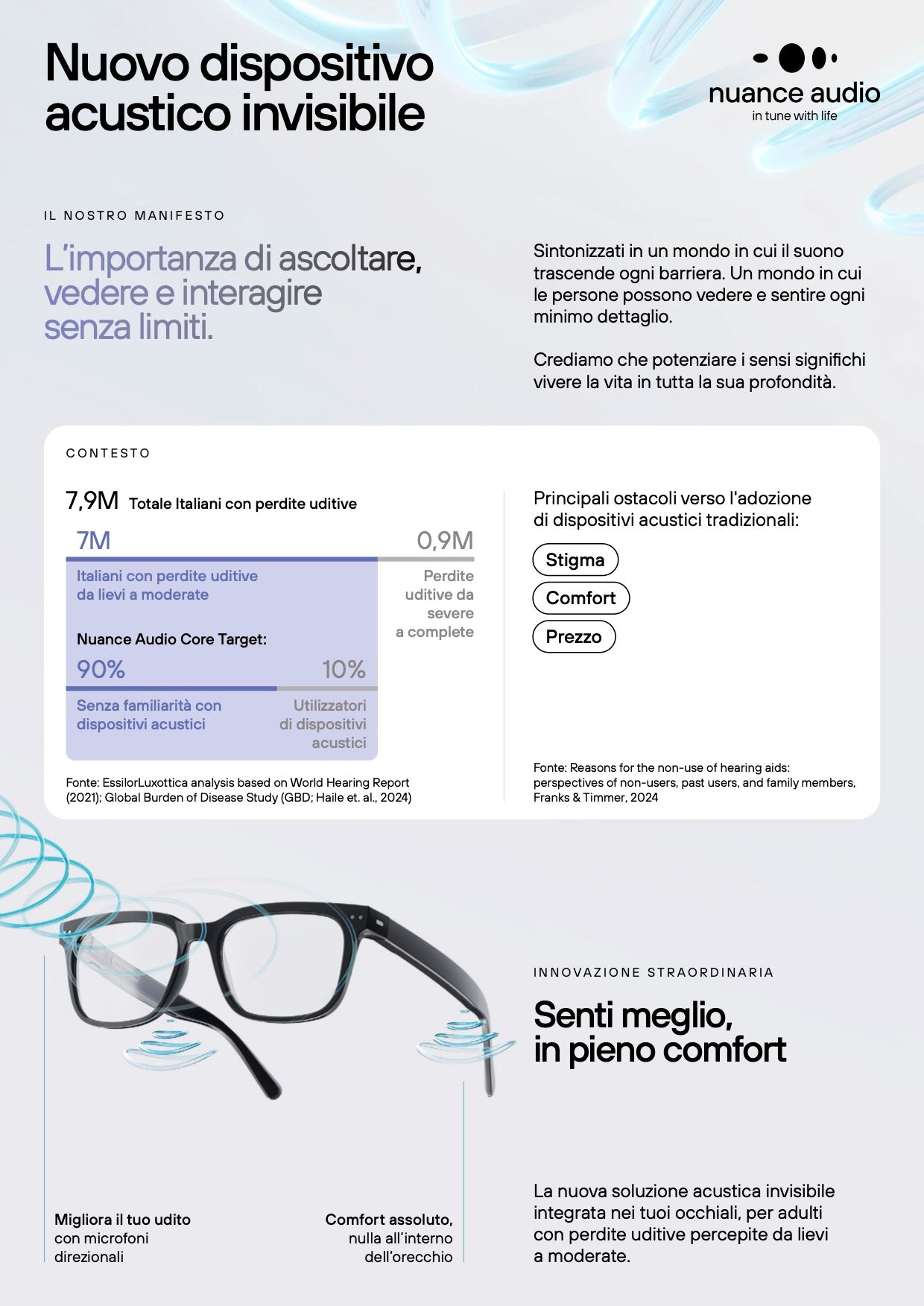
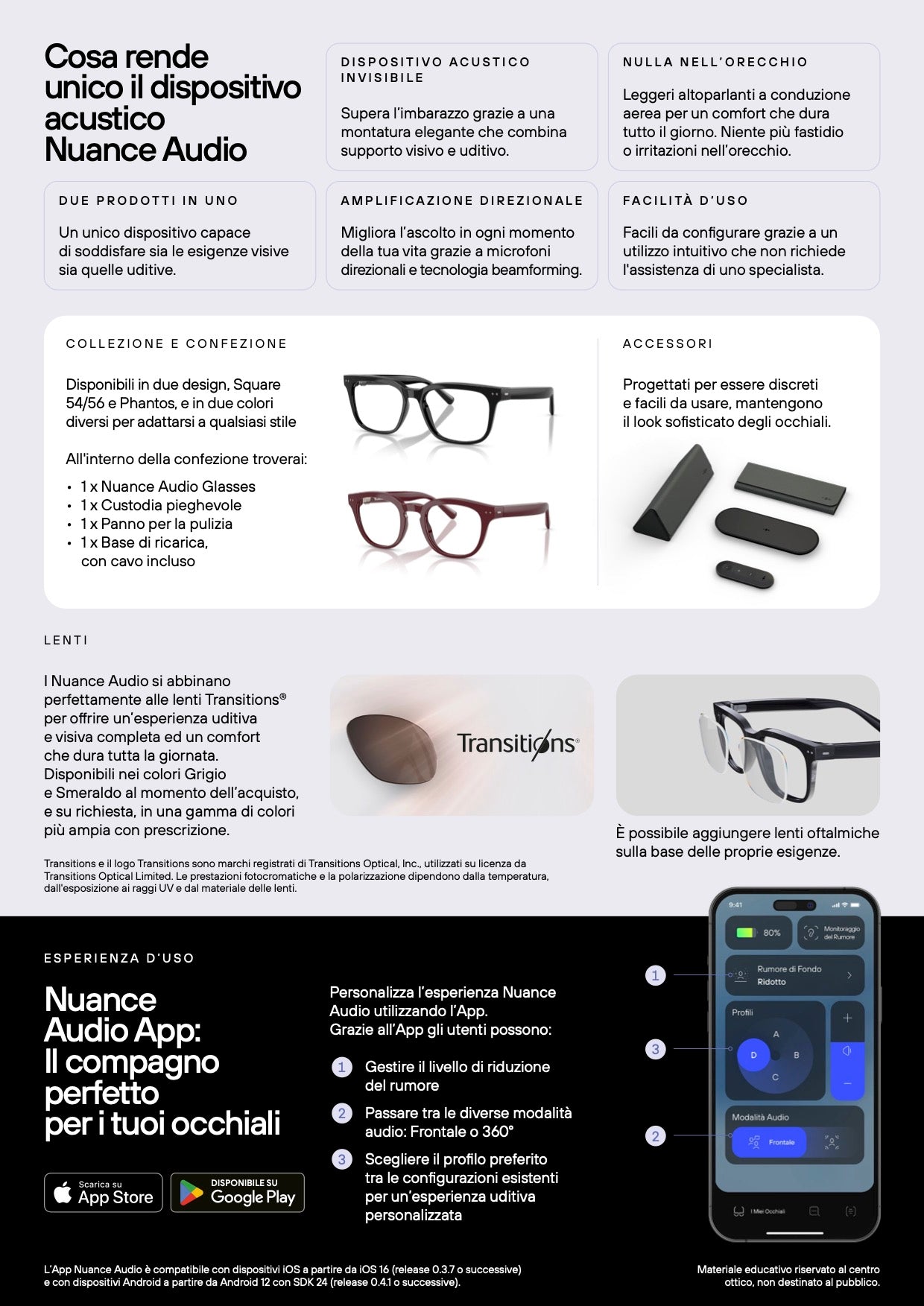
The first hearing glasses, exclusively in Macerata
Notes on childhood myopia and possible solutions.
Always discuss it with your ophthalmologist!
Myopia (short-sightedness) is a condition that makes distance vision blurred. It usually begins in childhood and gets progressively worse as the child grows.
The incidence of myopia is expected to rise significantly¹ with changing lifestyles: children spend more and more time on close-up visual tasks² such as digital devices, studying and reading, and less and less time outdoors. Hereditary, behavioural and environmental factors also play an important role.
Diagnosing myopia early in young people not only corrects their vision, but can help slow its progression and preserve their eyesight and eye health for the future.
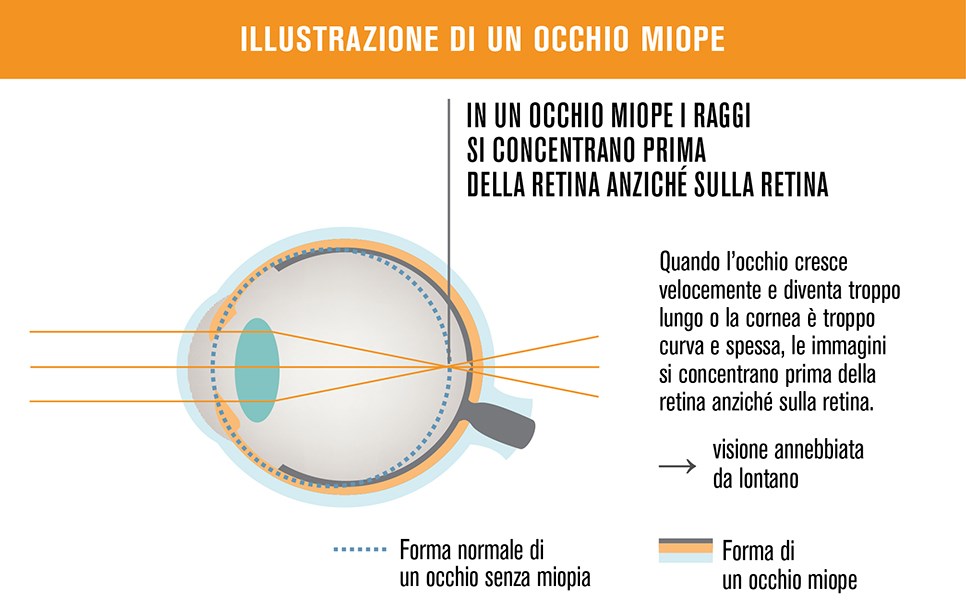
Dozens of international studies have shown that elongation of the eyeball may be the eye's attempt to reach emmetropia in response to the peripheral defocus produced by traditional myopia correction.
What we can do
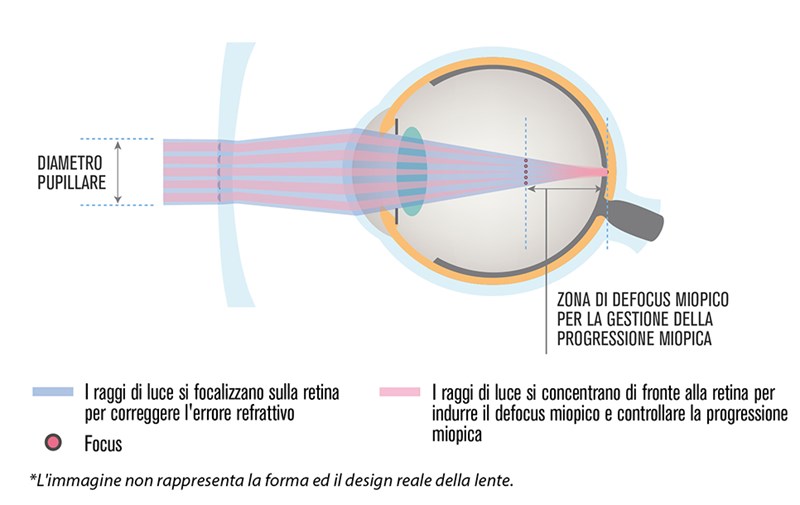
It has now been shown that focusing the image correctly on every part of the retina, including the periphery, slows the progression of myopia.
This requires special optical designs, never used before, which have recently come onto the market and are starting to show meaningful results and statistics.
Before reaching Europe, these systems were tested and developed in East Asia, where myopia is almost an epidemic.
Contact lenses
Contact lenses were the first to be used in this new approach to myopia control.
MiSight – CooperVision
Manufacturer's website – https://coopervision.it/misight
- Daily disposable soft contact lens suitable for myopic children
- MiSight 1 day corrects myopia so that children can enjoy clear vision without wearing glasses
- MiSight 1 day has a special optical design that can help slow the rate at which myopia progresses
MYLO – mark'ennovy
Manufacturer's website – https://markennovy.com/it/nostri_prodotti/mylo/
MYLO is a custom-made monthly silicone hydrogel contact lens designed specifically for myopia control. It is built with the patented Extended Depth of Focus (EDOF) technology from the Brien Holden Vision Institute, which slows myopia progression and allows easy adaptation to the lens, improving the overall wearing experience. MYLO is a monthly disposable lens with high water content and a low coefficient of friction, which together improve all-day comfort. The wide range of parameters and low modulus ensure excellent wear and easy handling, especially for young wearers.
Spectacle lenses
ZEISS – MyoCare
The result of more than a decade of ZEISS innovation and experience in managing myopia in Asian children, MyoCare is now also available in Europe, in response to a growing global need.

MiyoSmart – HOYA
Manufacturer's website – https://www.hoyavision.com/it/le-mie-esigenze/per-i-portatori/miyosmart/
MiyoSmart lenses with D.I.M.S. technology help reduce myopia progression by an average of 59% in children by controlling the growth of the eyeball⁷.
- A non-invasive solution that corrects myopia and at the same time effectively reduces its progression by an average of 59%.
- Slows axial eye growth by an average of 60%.
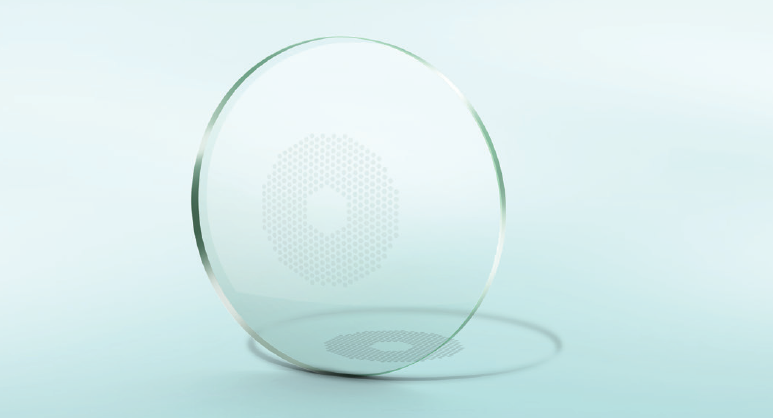
Essilor Stellest
Stellest lenses are Essilor's new solution for managing myopia in children. The lens contains a constellation of invisible micro-lenses that create a signal in front of the retina to guide eye growth and slow the progression of myopia, thanks to H.A.L.T.* technology.

When to act
Myopia usually progresses fastest between the ages of 8 and 13. These systems can be prescribed for any child or young person with certain typical signs, such as the absence of the slight hyperopia normally present in a growing eye, myopic parents, or myopia progressing by more than 0.25–0.50 dioptres a year.
Treatment can be started at any age at which myopia is progressing. The earlier it starts, while myopia is still low, the greater the chance of benefit.